
Built by students asking: what do I need to remember?
Integrade was created by students who worried about which past math skills they would need to pass their next class. It is designed for students carrying that same uncertainty into Calculus 1, Calculus 2, Linear Algebra & Matrix Transformations, or Applied Math 1 / ODEs.
Find the hidden gap
Meet the founders
“As students, we saw so many of our peers anxiously starting their next math class, wondering whether they remembered all the concepts they needed for the course. We were just like them. We created Integrade with students like us in mind, with the goal of helping them feel confident in math class.”




Review can be quick—or go all the way down.
Sometimes a student needs a two-minute reminder before moving on. Sometimes they need to rebuild the intuition, watch the structure move, and practice retrieving it until it sticks. Integrade is tailored for both.
Instead of assigning a broad chapter, it asks a sharper question: which exact past relationship is preventing the next idea from landing?
Quick review
Recall the missing rule and keep going.
In-depth
Rebuild the idea from intuition to recall.
From uncertainty to a plan
Not more review.
The right review.
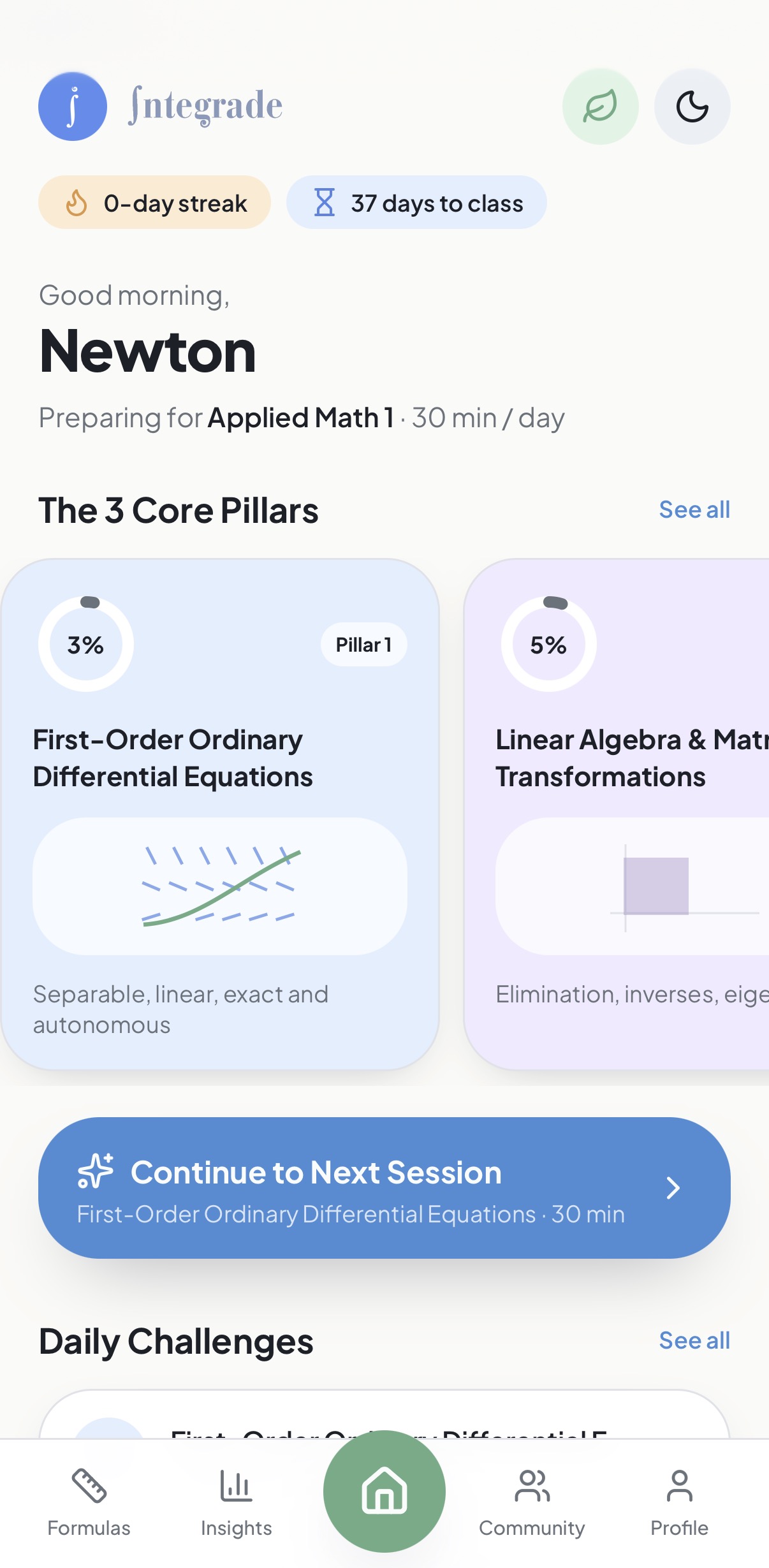
The right depth, right now.
Refresh one skill or unpack the whole concept.
Rigorous learning can still feel humane.
A wrong answer is a signal.
It often points to a specific missing prerequisite, not a lack of mathematical ability.
Intuition deserves a first draft.
Students should see and manipulate an idea before notation asks them to compress it.
Help should preserve agency.
A good hint returns the problem to the learner with more leverage—not less ownership.
Passive reading ends where motion begins.
Textbooks are powerful compression tools. They are less effective as a student’s first encounter with an invisible mechanism. Integrade expands the mechanism, lets the learner move it, and then compresses it back into mathematical language.
Read the formula
Manipulate the idea
Explain it yourself
See it. Connect it.
Use it. Recall it.
The sequence moves deliberately from Intuition Sandbox to Dual Coding, Breakdown (Guided Completion), and Mastery Practice—so each lesson starts with meaning and ends with independent recall.
Stage 1: Intuition Sandbox
Make the idea move.
Use interactive geometric models and dynamic sliders—like sliding a power to watch waves flatten—to build qualitative intuition before touching formulas.
Stage 2: Dual Coding
See what the symbols say.
Hear a synchronized explanation while animated visual mechanics split, color-code, and glide Product Rule terms into (u′ · v) + (u · v′).
Stage 3: Breakdown (Guided Completion)
Bridge symbols to numbers.
Deconstruct abstract variables into concrete numbers, then cross step-by-step scaffolded bridges toward independent completion.
Stage 4: Mastery Practice
Retrieve the rule that matters.
Use low-stakes active recall to identify the exact theorem or identity underneath the problem. Integrade never gives final answers — only the rule you are missing.
Research informs every handoff.
These peer-reviewed studies inform Integrade’s learning design; they are not product efficacy trials of Integrade itself. Each finding is translated into a specific student interaction.
01 · Active exploration
Peer-reviewedFreeman et al. · PNAS · 2014
A meta-analysis of 225 undergraduate STEM studies found active learning improved exam and concept-inventory performance by 0.47 standard deviations; lecture-only students were 1.5× more likely to fail.
In Integrade: The sandbox asks students to predict, manipulate, and interpret—not just watch.
Read the original study02 · Words paired with visuals
Peer-reviewedMayer & Anderson · JEP · 1992
Across two experiments, animation paired with concurrent explanation produced stronger problem-solving transfer than disconnected or single-format instruction.
In Integrade: Integrade synchronizes a formula’s language with the movement it describes.
Read the original study03 · Faded scaffolding
Peer-reviewedAtkinson, Renkl & Merrill · JEP · 2003
Successively removing worked steps supported near-transfer problem solving. The benefit did not reliably extend to far-transfer tasks—an important boundary on the finding.
In Integrade: Support recedes in small steps as students move from an example to independent use.
Read the original study04 · Retrieval practice
Peer-reviewedRoediger & Karpicke · Psychological Science · 2006
After one week, a prior-test condition recalled 56% of studied material versus 42% after repeated study, even though restudy created greater confidence.
In Integrade: Every lesson closes with recall before feedback, rather than another passive review.
Read the original studyHigher math should feel demanding—not mysterious.
Be part of the first cohort shaping a more transparent path into Calculus 1, Calculus 2, Linear Algebra & Matrix Transformations, and Applied Math 1 / ODEs.