
What Calculus 1 actually assumes you know
- Algebra fluency: Factoring, simplifying rational expressions, solving equations; you'll do this in nearly every problem.
- Functions: Notation f(x), composition, inverses, graphing; calculus is the study of how functions change.
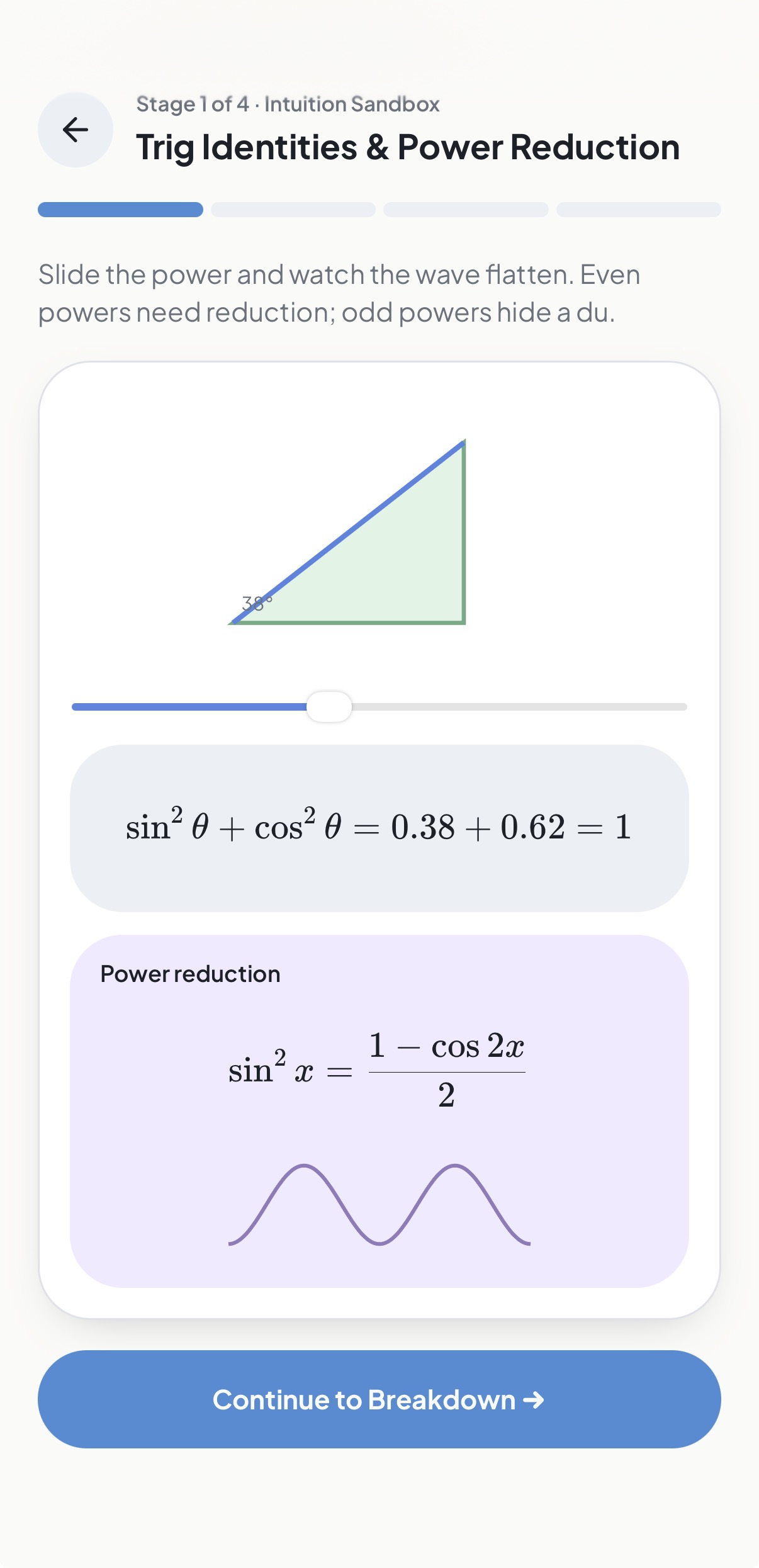
- Trigonometry: The unit circle, exact values, basic identities; trig shows up in limits, derivatives, and integrals from week one.
How to review without wasting your break
- Diagnose first: Don't re-study everything, find your gaps.
- Build intuition before formulas: Understand what a derivative means before memorizing rules.
- Use active recall: Test yourself from memory instead of re-reading notes; retrieval is what makes it stick.
- Don't pre-learn calculus: Memorizing procedures with no foundation backfires; fix the foundation instead.
How long does this take?
A focused 2–4 weeks at 30–45 minutes a day beats a panicked weekend. Consistency beats cramming.
Frequently asked questions
Do I need trig for Calculus 1?
Yes. Learn the unit circle and exact values for common angles. They appear early in limits and derivatives.
I'm really rusty on algebra. Where do I start?
Start with factoring and function notation. Both show up throughout calculus.
Should I learn derivatives before class?
No. Review the prerequisites first, and calculus will make more sense once the foundation is solid.